Mob : +91 92554 42103
Email id: iahrw2019@gmail.com
Mob : +91 92554 42103
Mob : +91 92554 42103
Email id: iahrw2019@gmail.com
Mob : +91 92554 42103

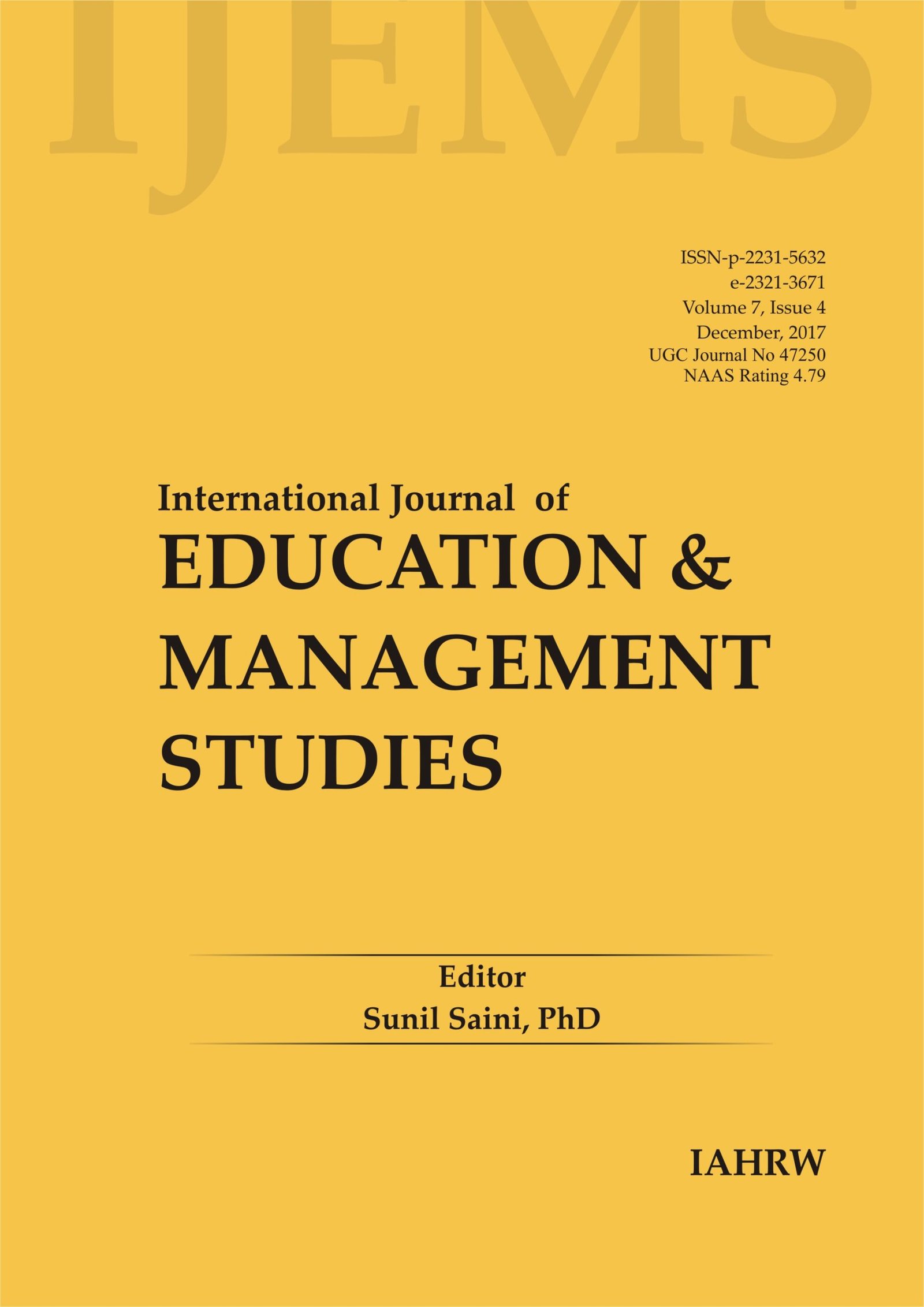
International Journal of Education and Management Studies (IJEMS) is an indexed, peer-reviewed and refereed journal published quarterly by the Indian Association of Health, Research, and Welfare (IAHRW). International Journal of Education and Management Studies likely aims to promote research and knowledge dissemination in the fields of education and management. Its objectives include fostering academic discussions on innovative teaching methodologies, educational policies, leadership strategies, human resource management, and organizational behavior. The journal focuses on areas such as pedagogy, curriculum development, educational psychology, business management, entrepreneurship, and corporate governance. Its goals are to publish high-quality, peer-reviewed research, encourage interdisciplinary collaboration, and contribute to the practical application of education and management theories for academic and professional growth. The journal is indexed with ProQuest, ProQuest Central, J-Gate, and National Academy of Agricultural Sciences (NAAS) Rating 4.58. IJEMS is being published regularly since 2011. For more details write to us to iahrw2019@gmail.com
Editor-in-Chief: Sunil Saini, PhD, Editorial Office: 1245/18, Moh. Sainian, Hisar, Haryana, India
Email: iahrw2019@gmail.com
Phone: 9255442103, 7988885490
Publisher: IAHRW Publications
ISSN: 2231-5632 (print version)
ISSN: 2321-3671 (electronic version)
Frequency: Quarterly (March, June, September and December)
Indexing: ProQuest, ( ProQuest Central Premium, ProQuest One Academy, ProQuest One Community College ), Index Copernicus International, J-Gate, Questia Library, Technion Israel Institute of Technology Library, National Academy of Agricultural Sciences (NAAS) Rating 4.58
CHIEF EDITOR
Sunil Saini, PhD
ORCHID ID: 0000-0002-5342-3424
Indian Association of Health, Research and Welfare, Hisar, Haryana, India
EDITORS
David Bennett, PhD, Charisma University, USA S. C. Kundu, PhD, Guru Jambheshwar University of Science and Technology, Hisar
B.K. Punia, PhD, Guru Jambheshwar University of Science and Technology, Hisar
Mahesh Thakur, PhD, Karve Institute of Social Sciences, Pune
Jaspreet Kaur, PhD, Punjabi University, Patiala
Vandana Punia, PhD, GJUS&T, Hisar, Haryana
Munish Nagpal, PhD, Deputy Commissioner, Govt of Haryana
Sangeeta Trama, PhD, Punjabi University Patiala
Sandeep Singh, PhD, GJUS&T, Hisar, Haryana
Email: iahrw2019@gmail.com
Phone: 9255442103
Publisher: IAHRW
ISSN: 2231-5632 (print version)
ISSN: 2321-3671 (electronic version)
Frequency: Quarterly
Indexing: ProQuest, ProQuest Central, Index Copernicus International, J-Gate, Questia Library, Technion Israel Institute of Technology Library
Author’s guidelines:
International Journal of Education and Management Studies (IJEMS) is a peer-reviewed research journal published quarterly by Indian Association of Health, Research and Welfare. The IJEMS is indexed with ProQuest, J-Gate, etc. The journal welcomes the submission of manuscripts that meet the general criteria of scientific excellence in the area of Education, Psychology and Management Studies and other related fields. IJEMS is published Quarterly (March, June, September and December).
Manuscripts should be submitted in the format outlined in the Publication Manual of the American Psychological Association (6th edition) and should be sent via email at iahrw2010@gmail.com. The papers are reviewed by professional reviewers who have specialized expertise in the respective area, and to judge the quality of the paper in a time bound and confidential manner. The paper shall be review by double blind review process.
Permission
Authors wishing to include figures, tables, or text passages that have already been published elsewhere are required to obtain permission from the copyright owner(s) for both the print and online format and to include evidence that such permission has been granted when submitting their papers. Any material received without such evidence will be assumed to originate from the authors.
Online Submission
Please follow the hyperlink “Submit online” on the right and upload all of your manuscript files following the instructions given on the screen.
The title page should include:
• The name(s) of the author(s)
• A concise and informative title
• The affiliation(s) and address(es) of the author(s)
• The e-mail address, and telephone number(s) of the corresponding author
Abstract
Please provide an abstract of 150 to 250 words. The abstract should not contain any undefined abbreviations or unspecified references.
Keywords
Please provide 4 to 6 keywords which can be used for indexing purposes.
Main Text
Manuscripts should be submitted in Word.
Tables
Tables should be as per APA format
References
References should be as per APA format as follows
• Journal article
Panda, T., Lamba, V., Goyal, N., Saini, S., Boora, S., Cruz. (2018). Psychometric Testing in Schools. Indian Journal of Health and Wellbeing, 8(2), 213–245.
• Article by DOI
Slifka, M. K., & Whitton, J. L. (2000) Clinical implications of dysregulated cytokine production. Journal of Molecular Medicine, doi:10.1007/s001090000086
• Book
Calfee, R. C., & Valencia, R. R. (1991). APA guide to preparing manuscripts for journal publication. Washington, DC: American Psychological Association.
• Book chapter
O’Neil, J. M., & Egan, J. (1992). Men’s and women’s gender role journeys: Metaphor for healing, transition, and transformation. In B. R. Wainrib (Ed.), Gender issues across the life cycle (pp. 107–123). New York: Springer.
• Online document
Abou-Allaban, Y., Dell, M. L., Greenberg, W., Lomax, J., Peteet, J., Torres, M., & Cowell, V. (2006). Religious/spiritual commitments and psychiatric practice. Resource document. American Psychiatric Association.
https://web.archive.org/web/20100308014645/http://www.psych.org:80/edu/other_res/lib_archives/archives/200604.pdf. Accessed 25 June 2007.
Copyright form
Authors will be asked to transfer copyright of the article to the Publisher (or grant the Publisher exclusive publication and dissemination rights). This will ensure the widest possible protection and dissemination of information under copyright laws.
Proof reading
The purpose of the proof is to check for typesetting or conversion errors and the completeness and accuracy of the text, tables and figures. Substantial changes in content, e.g., new results, corrected values, title and authorship, are not allowed without the approval of the Editor. After online publication, further changes can only be made in the form of an Erratum, which will be hyperlinked to the article.
Ethical Guidelines for the author
• Authors should adhere to publication requirements that submitted work is original and has not been published elsewhere in any language. Work should not be submitted concurrently to more than one publication unless the editors have agreed to co-publication. If articles are co-published this fact should be made clear to readers.
• Copyright material (e.g. tables, figures or extensive quotations) should be reproduced only with appropriate permission and acknowledgement.
• Relevant previous work and publications, both by other researchers and the authors’ own, should be properly acknowledged and referenced.
• Data, text, figures or ideas originated by other researchers should be properly acknowledged and should not be presented as if they were the authors’ own
• All sources of research funding, including direct and indirect financial support, supply of equipment or materials, and other support (such as specialist statistical or writing assistance) should be disclosed.
• Authors should disclose the role of the research funder(s) or sponsor (if any) in the research design, execution, analysis, interpretation and reporting
• The research literature serves as a record not only of what has been discovered but also of who made the discovery. The authorship of research publications should therefore accurately reflect individuals’ contributions to the work and its reporting.
• In cases where major contributors are listed as authors while those who made less substantial, or purely technical, contributions to the research or to the publication are listed in an acknowledgement section, the criteria for authorship and acknowledgement should be agreed at the start of the project.
• Researchers should ensure that only those individuals who meet authorship criteria (i.e. made a substantial contribution to the work) are rewarded with authorship and that deserving authors are not omitted. Institutions and journal editors should encourage practices that prevent guest, gift, and ghost authorship.
• All authors should agree to be listed and should approve the submitted and accepted versions of the publication. Any change to the author list should be approved by all authors including any who have been removed from the list. The corresponding author should act as a point of contact between the editor and the other authors and should keep co-authors informed and involve them in major decisions about the publication (e.g. responding to reviewers’ comments).
• Authors should work with the editor or publisher to correct their work promptly if errors or omissions are discovered after publication.
• Authors should abide by relevant conventions, requirements, and regulations to make materials, reagents, software or datasets available to other researchers who request them. Researchers, institutions, and funders should have clear policies for handling such requests. Authors must also follow relevant journal standards. While proper acknowledgement is expected, researchers should not demand authorship as a condition for sharing materials.
• Authors should follow publishers’ requirements that work is not submitted to more than one publication for consideration at the same time.
• Authors should inform the editor if they withdraw their work from review, or choose not to respond to reviewer comments after receiving a conditional acceptance.
• Authors should respond to reviewers’ comments in a professional and timely manner.
• Appropriate approval, licensing or registration should be obtained before the research begins and details should be provided in the report (e.g. Institutional Review Board, Research Ethics Committee approval, national licensing authorities for the use of animals).
• If requested by editors, authors should supply evidence that reported research received the appropriate approval and was carried out ethically (e.g. copies of approvals, licences, participant consent forms).
• Researchers should not generally publish or share identifiable individual data collected in the course of research without specific consent from the individual (or their representative). Researchers should remember that many scholarly journals are now freely available on the internet, and should therefore be mindful of the risk of causing danger or upset to unintended readers (e.g. research participants or their families who recognise themselves from case studies, descriptions, images or pedigrees).
• The appropriate statistical analyses should be determined at the start of the study and a data analysis plan for the prespecified outcomes should be prepared and followed.
• Researchers should publish all meaningful research results that might contribute to understanding. In particular, there is an ethical responsibility to publish the findings of all clinical trials. The publication of unsuccessful studies or experiments that reject a hypothesis may help prevent others from wasting time and resources on similar projects. If findings from small studies and those that fail to reach statistically significant results can be combined to produce more useful information (e.g. by meta-analysis) then such findings should be published.
• Authors should supply research protocols to journal editors if requested (e.g. for clinical trials) so that reviewers and editors can compare the research report to the protocol to check that it was carried out as planned and that no relevant details have been omitted. Researchers should follow relevant requirements for clinical trial registration and should include the trial registration number in all publications arising from the trial.
Plagiarism
The acceptance rate depends on the below 10% plagiarism (Turnitin Software) and reviewers’ feedback and recommendations.
AI-Generated Content Policy
The Indian Journal of Health and Wellbeing follows ethical publishing standards and may have specific policies regarding the use of AI in research and writing. Authors are expected to disclose the use of AI tools in manuscript preparation, ensuring that AI-generated content does not compromise originality, accuracy, or ethical integrity. For precise guidelines, it is recommended to refer to the journal’s official policy. The AI content by Turnitin should be below 15%
Retraction, Correction, and Expression of Concern Policy
The Indian Journal of Health and Wellbeing (IJHW) is committed to maintaining the integrity of the scholarly record. The journal follows the principles and recommendations of the Committee on Publication Ethics (COPE) in handling corrections, expressions of concern, and retractions.
Corrections (Erratum/Corrigendum)
A correction may be issued when a published article contains significant errors that affect the accuracy, indexing, interpretation, or reputation of the publication but do not invalidate the study’s findings. Corrections may be initiated by authors, editors, or readers.
• An Erratum is issued when the error originates from the journal or publisher.
• A Corrigendum is issued when the error originates from the author(s).
• All corrections will be linked electronically to the original article and clearly identify the changes made.
Expression of Concern
The Editor-in-Chief may publish an Expression of Concern when substantial doubts arise regarding the integrity, reliability, ethical compliance, or authorship of a published article, and an investigation is ongoing. The notice will remain associated with the article until a final decision is reached.
Retraction Policy
Articles may be retracted if:
• There is clear evidence that findings are unreliable due to misconduct or honest error.
• The work constitutes plagiarism, duplicate publication, or redundant publication.
• Data fabrication, falsification, image manipulation, or unethical research practices are identified.
• Serious violations of publication ethics are confirmed.
Retraction Procedure
Appeals
Authors may appeal editorial decisions regarding corrections, expressions of concern, or retractions by submitting a written explanation and supporting documentation to the Editor-in-Chief. Appeals will be reviewed independently, and the final decision of the Editorial Board shall be binding. The journal reserves the right to update published content when necessary to protect the integrity of the scientific record and the interests of readers, researchers, and the public.
Editor-in-Chief: Sunil Saini, PhD, Editorial Office: 1245/18, Moh. Sainian, Hisar, Haryana, India
Email: iahrw2019@gmail.com,
Phone: 9255442103
Publisher: IAHRW
ISSN: 2231-5632 (print version)
ISSN: 2321-3671 (electronic version)
Frequency: Quarterly
Indexing: ProQuest, ProQuest Central, J-Gate, Questia Library, Technion Israel Institute of Technology Library
Peer Review
All content of the International Journal of Education and Management Studies is subject to peer-review. The Editor first checks and evaluates the submitted manuscript, examining its fit and quality regarding its significance, manuscript format, research quality. If it is suitable for potential pubication, the Editor directs the manuscript for Plagiarism check, and the minimum similarity acceptable is below 20% without references. After that, editor directs the manuscript to two reviewers, with both being experts in the field. This journal employs double-blind review, wehre the author and referee remains anonymous througout the process. Referees are asked to avaluate whetehr the manuscript is original, makes a theoretical contribution to the study, methodoogy is sound, follos appropriate ethical guidelines, whether the results are clearly presented and sufficient supporting studies are given and support the conclusion. The time for evaluation is approximately one month. The Editor’s decision will be sent to the author with recommendations made by the referees. Revised manuscripts might be returned to the initial referees who may then request another revision of the manuscript. After both reviewer’s feedback, the Editor decides if the manuscript will be rejected, accepted with revision needed or accepted for publication. The Editor’s decision is final. Regerees advise the Editor, who is responsible for the final decision to accept or reject the article.
Compaint policy
We ain to respond to and resolve all complaints quickly. All complaints will be acknowledged within a week. For all matters related to the policies, procedures, editorial content, and actions of the editorial staff, the decision of the Editor-in-Chief shall be final. The procedure to make a complaint is easy. It can be made by writing an email to editor: iahrw@iahrw.org
Confict of Interest Policy
Transparency and objectiity in research are essential for publication in this journal. These principles are strictily followed in our peer review process and decision of publication. Manuscript submissions are assigned to reviewers in an effort to minimize potential conflicts of interest. After papers are assigned, individual reviewers are required to inform the editor-in-chief of any conflict.
1. Initial Manuscript Evaluation
All submitted manuscripts undergo an initial editorial screening to assess their relevance to the journal’s scope, originality, scientific quality, ethical compliance, adherence to submission guidelines, and overall suitability for peer review.
2. Number of Referees Assigned
Manuscripts that successfully pass the initial evaluation are typically sent to two independent expert reviewers for double-blind peer review. In cases of conflicting recommendations, a third reviewer may be invited.
3. Delivery of Peer Review Feedback
Reviewer comments and recommendations are communicated to the corresponding author through the journal’s editorial system or email. Anonymous reviewer reports are provided along with editorial guidance for revision, where applicable.
4. Typical Length of Peer Review
The peer review process generally takes 4–8 weeks, depending on reviewer availability, the complexity of the manuscript, and the timeliness of responses.
5. Handling of Revise and Resubmit Requests
Authors receiving a revision decision are requested to submit a revised manuscript along with a detailed point-by-point response to reviewers’ comments within the specified timeframe. Revised submissions may be returned to the original reviewers for further evaluation when necessary.
6. Editorial Decisions
Based on reviewers’ recommendations and editorial assessment, one of the following decisions may be communicated to the author:
The final decision is made by the Editor-in-Chief or the Editorial Board and is communicated to the corresponding author through email along with the relevant comments and recommendations.
Page: 165-168 Preety Sihan1, Ashok Kumar2, Satyakaam Malik3, Rajesh Kumar4, Anil Kumar5, K.K. Yadav6, and Jasvinder Kaur7 (Directorate of Extension Education, CCS Haryana Agricultural University, Hisar, Haryana1, 2,4, 6, EEI Nelokheri, CCS Haryana Agricultural University, Nelokheri, Haryana3, 7, and KVK Yamunanagar, CCS Haryana Agricultural University, Nelokheri, Haryana5) Page: 165-168Preety Sihan1, Ashok Kumar2, Satyakaam Malik3, Rajesh Kumar4, Anil Kumar5, K.K. Yadav6, and Jasvinder… |
Page: 169-175 Harbans Lal (SNDT Women's University, Director-Forum of Safety Culture, Mumbai, Maharashtra) Page: 169-175Harbans Lal (SNDT Women’s University, Director-Forum of Safety Culture, Mumbai, Maharashtra)This paper deliberates that… |
Page: 176-178 Ankita Sharma1, Sunita Mehla2, Suman Ghalawat3, Jitender Kumar Bhatia4, and Nitin Bhardwaj5 (Department of Business Management, CCS Haryana Agricultural University, Hisar, Haryana1, 2, 3, Directorate of Human Resource Management, CCS Haryana Agricultural University, Hisar, Haryana4, and Department of Mathematics & Statistics, CCS Haryana Agricultural University, Hisar, Haryana5) Page: 176-178Ankita Sharma1, Sunita Mehla2, Suman Ghalawat3, Jitender Kumar Bhatia4, and Nitin Bhardwaj5 (Department of… |
Page: 179-182 Virender Singh1, Ashok Kumar2, Satyakaam Malik3, Rajesh Kumar4, Anil Kumar5, K.K. Yadav6, and Jasvinder Kaur7 (Directorate of Extension Education, CCS Haryana Agricultural University, Hisar, Haryana1,2,4, 6, EEI Nelokheri, CCS Haryana Agricultural University, Nelokheri, Haryana3, 7, and KVK Yamunanagar, CCS Haryana Agricultural University, Yamunanagar, Haryana5) Page: 179-182Virender Singh1, Ashok Kumar2, Satyakaam Malik3, Rajesh Kumar4, Anil Kumar5, K.K. Yadav6, and Jasvinder… |
Page: 183-187 Satyakaam Malik1, Jasvinder Kaur2, Kailash Saini3, Ashok Kumar4, K.K. Yadav5, Atul Dhingra6, Abhilash7, and Rekha Malik8 (Department of Business Management, CCS Haryana Agricultural University, Hisar, Haryana1,6, Extension Education Institute, Nilokheri, Karnal, Haryana1,2, ICAR Indian Institute of Wheat and Barley Research, Agrasain Marg, Karnal, Haryana8,3, Directorate of Extension Education, CCS Haryana Agricultural University, Hisar, Haryana4,5, ICAR Central Island, Agricultural Research Institute, Port Blair, Andaman & Nicobar Islands7) Page: 183-187Satyakaam Malik1, Jasvinder Kaur2, Kailash Saini3, Ashok Kumar4, K.K. Yadav5, Atul Dhingra6, Abhilash7, and… |
Page: 188-192 Rashmi Tyagi1, Rajesh Bhatt2, and Vishakha Karkwal3 (Department of Psychology, DAV Collage, Dehradun, Uttarakhand1, 3 and Department of Psychology, Doon University, Dehradun, Uttarakhand2) Page: 188-192Rashmi Tyagi1, Rajesh Bhatt2, and Vishakha Karkwal3 (Department of Psychology, DAV Collage, Dehradun, Uttarakhand1… |
Page: 193-197 Vanshri Garde1 and Yogesh Garde2 (Naran Lala Institute of Teacher Education, VNSGU, Navsari, Gujarat1 and Department of Agricultural Statistics, NMCA, NAU, Navsari, Gujarat2) Page: 193-197Vanshri Garde1 and Yogesh Garde2 (Naran Lala Institute of Teacher Education, VNSGU, Navsari, Gujarat1… |
Page: 198-200 Anamika, Suman Ghalawat, and Megha Goyal (Department of Business Management, CCSHAU, Hisar, Haryana) Page: 198-200Anamika, Suman Ghalawat, and Megha Goyal (Department of Business Management, CCSHAU, Hisar, Haryana)Tomatoes are… |
Page: 201-205 Satyakaam Malik1, Jasvinder Kaur2, Abhilash3, Atul Dhingra4, and Rekha Malik5 (Department of Business Management, CCS Haryana Agricultural University, Hisar, Haryana1,4, Extension Education Institute, Nilokheri, Karnal, Haryana1, 2, ICAR–Central Island Agricultural Research Institute, Port Blair, Andaman & Nicobar Islands3, and ICAR–Indian Institute of Wheat and Barley Research, Agrasain Marg, Karnal, Haryana5) Page: 201-205Satyakaam Malik1, Jasvinder Kaur2, Abhilash3, Atul Dhingra4, and Rekha Malik5 (Department of Business Management… |
Page: 206-210 Vaishali1, Shruti Rastogi2, and Harsh Gandhar3 (Department of Evening Studies-MDRC, Panjab University, Chandigarh1, Department of Economics, Panjab University, Chandigarh2, and Department of Economics, University School of Open Learning, Panjab University, Chandigarh3) Page: 206-210Vaishali1, Shruti Rastogi2, and Harsh Gandhar3 (Department of Evening Studies-MDRC, Panjab University, Chandigarh1, Department… |
Page: 211-214 Vitasta Dhawan and Tejpreet Kaur Kang (Department of Human Development & Family Studies, Punjab Agricultural University, Ludhiana, Punjab) Page: 211-214Vitasta Dhawan and Tejpreet Kaur Kang (Department of Human Development & Family Studies, Punjab… |
Page: 215-221 Satyakaam Malik1, Jasvinder Kaur2, Abhilash3, Atul Dhingra4, and Rekha Malik5 (Department of Business Management, CCS Haryana Agricultural University, Hisar, Haryana1,4, Extension Education Institute, Nilokheri, Karnal, Haryana1, 2, ICAR–Central Island Agricultural Research Institute, Port Blair, Andaman & Nicobar Islands3, and ICAR–Indian Institute of Wheat and Barley Research, Agrasain Marg, Karnal, Haryana5) Page: 215-221Satyakaam Malik1, Jasvinder Kaur2, Abhilash3, Atul Dhingra4, and Rekha Malik5 (Department of Business Management… |