
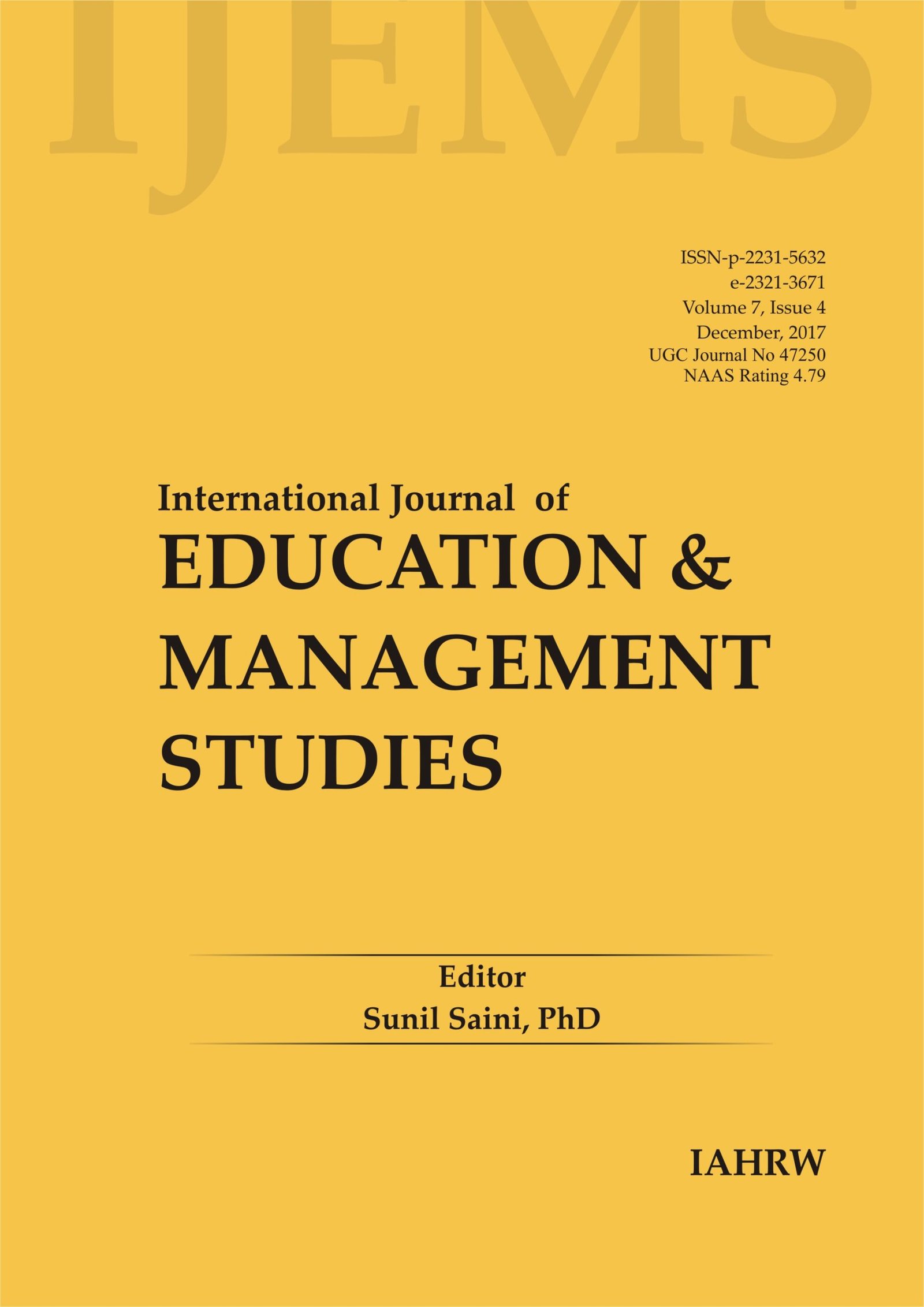
About this Journal
Editorial Board
Sample paper
Submit your Article
Authors and Ethical Guidelines
Peer Review Policy
About this Journal
International Journal of Education and Management Studies (IJEMS) is an indexed, peer-reviewed and refereed journal published quarterly by the Indian Association of Health, Research, and Welfare (IAHRW). International Journal of Education and Management Studies likely aims to promote research and knowledge dissemination in the fields of education and management. Its objectives include fostering academic discussions on innovative teaching methodologies, educational policies, leadership strategies, human resource management, and organizational behavior. The journal focuses on areas such as pedagogy, curriculum development, educational psychology, business management, entrepreneurship, and corporate governance. Its goals are to publish high-quality, peer-reviewed research, encourage interdisciplinary collaboration, and contribute to the practical application of education and management theories for academic and professional growth. The journal is indexed with ProQuest, ProQuest Central, J-Gate, and National Academy of Agricultural Sciences (NAAS) Rating 4.58. IJEMS is being published regularly since 2011. For more details write to us to iahrw2019@gmail.com
Editor-in-Chief: Sunil Saini, PhD, Editorial Office: 1245/18, Moh. Sainian, Hisar, Haryana, India
Email: iahrw2019@gmail.com
Phone: 9255442103, 7988885490
Publisher: IAHRW Publications
ISSN: 2231-5632 (print version)
ISSN: 2321-3671 (electronic version)
Frequency: Quarterly (March, June, September and December)
Indexing: ProQuest, ( ProQuest Central Premium, ProQuest One Academy, ProQuest One Community College ), Index Copernicus International, J-Gate, Questia Library, Technion Israel Institute of Technology Library, National Academy of Agricultural Sciences (NAAS) Rating 4.58
Editorial Board
CHIEF EDITOR
Sunil Saini, PhD
ORCHID ID: 0000-0002-5342-3424
Indian Association of Health, Research and Welfare, Hisar, Haryana, India
EDITORS
David Bennett, PhD, Charisma University, USA S. C. Kundu, PhD, Guru Jambheshwar University of Science and Technology, Hisar
B.K. Punia, PhD, Guru Jambheshwar University of Science and Technology, Hisar
Mahesh Thakur, PhD, Karve Institute of Social Sciences, Pune
Jaspreet Kaur, PhD, Punjabi University, Patiala
Vandana Punia, PhD, GJUS&T, Hisar, Haryana
Munish Nagpal, PhD, Deputy Commissioner, Govt of Haryana
Sangeeta Trama, PhD, Punjabi University Patiala
Sandeep Singh, PhD, GJUS&T, Hisar, Haryana
Email: iahrw2019@gmail.com
Phone: 9255442103
Publisher: IAHRW
ISSN: 2231-5632 (print version)
ISSN: 2321-3671 (electronic version)
Frequency: Quarterly
Indexing: ProQuest, ProQuest Central, Index Copernicus International, J-Gate, Questia Library, Technion Israel Institute of Technology Library
Sample paper
Submit your Article
Authors and Ethical Guidelines
Author’s guidelines:
International Journal of Education and Management Studies (IJEMS) is a peer-reviewed research journal published quarterly by Indian Association of Health, Research and Welfare. The IJEMS is indexed with ProQuest, J-Gate, etc. The journal welcomes the submission of manuscripts that meet the general criteria of scientific excellence in the area of Education, Psychology and Management Studies and other related fields. IJEMS is published Quarterly (March, June, September and December).
Manuscripts should be submitted in the format outlined in the Publication Manual of the American Psychological Association (6th edition) and should be sent via email at iahrw2010@gmail.com. The papers are reviewed by professional reviewers who have specialized expertise in the respective area, and to judge the quality of the paper in a time bound and confidential manner. The paper shall be review by double blind review process.
Permission
Authors wishing to include figures, tables, or text passages that have already been published elsewhere are required to obtain permission from the copyright owner(s) for both the print and online format and to include evidence that such permission has been granted when submitting their papers. Any material received without such evidence will be assumed to originate from the authors.
Online Submission
Please follow the hyperlink “Submit online” on the right and upload all of your manuscript files following the instructions given on the screen.
The title page should include:
• The name(s) of the author(s)
• A concise and informative title
• The affiliation(s) and address(es) of the author(s)
• The e-mail address, and telephone number(s) of the corresponding author
Abstract
Please provide an abstract of 150 to 250 words. The abstract should not contain any undefined abbreviations or unspecified references.
Keywords
Please provide 4 to 6 keywords which can be used for indexing purposes.
Main Text
Manuscripts should be submitted in Word.
Tables
Tables should be as per APA format
References
References should be as per APA format as follows
• Journal article
Panda, T., Lamba, V., Goyal, N., Saini, S., Boora, S., Cruz. (2018). Psychometric Testing in Schools. Indian Journal of Health and Wellbeing, 8(2), 213–245.
• Article by DOI
Slifka, M. K., & Whitton, J. L. (2000) Clinical implications of dysregulated cytokine production. Journal of Molecular Medicine, doi:10.1007/s001090000086
• Book
Calfee, R. C., & Valencia, R. R. (1991). APA guide to preparing manuscripts for journal publication. Washington, DC: American Psychological Association.
• Book chapter
O’Neil, J. M., & Egan, J. (1992). Men’s and women’s gender role journeys: Metaphor for healing, transition, and transformation. In B. R. Wainrib (Ed.), Gender issues across the life cycle (pp. 107–123). New York: Springer.
• Online document
Abou-Allaban, Y., Dell, M. L., Greenberg, W., Lomax, J., Peteet, J., Torres, M., & Cowell, V. (2006). Religious/spiritual commitments and psychiatric practice. Resource document. American Psychiatric Association.
https://web.archive.org/web/20100308014645/http://www.psych.org:80/edu/other_res/lib_archives/archives/200604.pdf. Accessed 25 June 2007.
Copyright form
Authors will be asked to transfer copyright of the article to the Publisher (or grant the Publisher exclusive publication and dissemination rights). This will ensure the widest possible protection and dissemination of information under copyright laws.
Proof reading
The purpose of the proof is to check for typesetting or conversion errors and the completeness and accuracy of the text, tables and figures. Substantial changes in content, e.g., new results, corrected values, title and authorship, are not allowed without the approval of the Editor. After online publication, further changes can only be made in the form of an Erratum, which will be hyperlinked to the article.
Ethical Guidelines for the author
• Authors should adhere to publication requirements that submitted work is original and has not been published elsewhere in any language. Work should not be submitted concurrently to more than one publication unless the editors have agreed to co-publication. If articles are co-published this fact should be made clear to readers.
• Copyright material (e.g. tables, figures or extensive quotations) should be reproduced only with appropriate permission and acknowledgement.
• Relevant previous work and publications, both by other researchers and the authors’ own, should be properly acknowledged and referenced.
• Data, text, figures or ideas originated by other researchers should be properly acknowledged and should not be presented as if they were the authors’ own
• All sources of research funding, including direct and indirect financial support, supply of equipment or materials, and other support (such as specialist statistical or writing assistance) should be disclosed.
• Authors should disclose the role of the research funder(s) or sponsor (if any) in the research design, execution, analysis, interpretation and reporting
• The research literature serves as a record not only of what has been discovered but also of who made the discovery. The authorship of research publications should therefore accurately reflect individuals’ contributions to the work and its reporting.
• In cases where major contributors are listed as authors while those who made less substantial, or purely technical, contributions to the research or to the publication are listed in an acknowledgement section, the criteria for authorship and acknowledgement should be agreed at the start of the project.
• Researchers should ensure that only those individuals who meet authorship criteria (i.e. made a substantial contribution to the work) are rewarded with authorship and that deserving authors are not omitted. Institutions and journal editors should encourage practices that prevent guest, gift, and ghost authorship.
• All authors should agree to be listed and should approve the submitted and accepted versions of the publication. Any change to the author list should be approved by all authors including any who have been removed from the list. The corresponding author should act as a point of contact between the editor and the other authors and should keep co-authors informed and involve them in major decisions about the publication (e.g. responding to reviewers’ comments).
• Authors should work with the editor or publisher to correct their work promptly if errors or omissions are discovered after publication.
• Authors should abide by relevant conventions, requirements, and regulations to make materials, reagents, software or datasets available to other researchers who request them. Researchers, institutions, and funders should have clear policies for handling such requests. Authors must also follow relevant journal standards. While proper acknowledgement is expected, researchers should not demand authorship as a condition for sharing materials.
• Authors should follow publishers’ requirements that work is not submitted to more than one publication for consideration at the same time.
• Authors should inform the editor if they withdraw their work from review, or choose not to respond to reviewer comments after receiving a conditional acceptance.
• Authors should respond to reviewers’ comments in a professional and timely manner.
• Appropriate approval, licensing or registration should be obtained before the research begins and details should be provided in the report (e.g. Institutional Review Board, Research Ethics Committee approval, national licensing authorities for the use of animals).
• If requested by editors, authors should supply evidence that reported research received the appropriate approval and was carried out ethically (e.g. copies of approvals, licences, participant consent forms).
• Researchers should not generally publish or share identifiable individual data collected in the course of research without specific consent from the individual (or their representative). Researchers should remember that many scholarly journals are now freely available on the internet, and should therefore be mindful of the risk of causing danger or upset to unintended readers (e.g. research participants or their families who recognise themselves from case studies, descriptions, images or pedigrees).
• The appropriate statistical analyses should be determined at the start of the study and a data analysis plan for the prespecified outcomes should be prepared and followed.
• Researchers should publish all meaningful research results that might contribute to understanding. In particular, there is an ethical responsibility to publish the findings of all clinical trials. The publication of unsuccessful studies or experiments that reject a hypothesis may help prevent others from wasting time and resources on similar projects. If findings from small studies and those that fail to reach statistically significant results can be combined to produce more useful information (e.g. by meta-analysis) then such findings should be published.
• Authors should supply research protocols to journal editors if requested (e.g. for clinical trials) so that reviewers and editors can compare the research report to the protocol to check that it was carried out as planned and that no relevant details have been omitted. Researchers should follow relevant requirements for clinical trial registration and should include the trial registration number in all publications arising from the trial.
Plagiarism
The acceptance rate depends on the below 10% plagiarism (Turnitin Software) and reviewers’ feedback and recommendations.
AI-Generated Content Policy
The Indian Journal of Health and Wellbeing follows ethical publishing standards and may have specific policies regarding the use of AI in research and writing. Authors are expected to disclose the use of AI tools in manuscript preparation, ensuring that AI-generated content does not compromise originality, accuracy, or ethical integrity. For precise guidelines, it is recommended to refer to the journal’s official policy. The AI content by Turnitin should be below 15%
Retraction, Correction, and Expression of Concern Policy
The Indian Journal of Health and Wellbeing (IJHW) is committed to maintaining the integrity of the scholarly record. The journal follows the principles and recommendations of the Committee on Publication Ethics (COPE) in handling corrections, expressions of concern, and retractions.
Corrections (Erratum/Corrigendum)
A correction may be issued when a published article contains significant errors that affect the accuracy, indexing, interpretation, or reputation of the publication but do not invalidate the study’s findings. Corrections may be initiated by authors, editors, or readers.
• An Erratum is issued when the error originates from the journal or publisher.
• A Corrigendum is issued when the error originates from the author(s).
• All corrections will be linked electronically to the original article and clearly identify the changes made.
Expression of Concern
The Editor-in-Chief may publish an Expression of Concern when substantial doubts arise regarding the integrity, reliability, ethical compliance, or authorship of a published article, and an investigation is ongoing. The notice will remain associated with the article until a final decision is reached.
Retraction Policy
Articles may be retracted if:
• There is clear evidence that findings are unreliable due to misconduct or honest error.
• The work constitutes plagiarism, duplicate publication, or redundant publication.
• Data fabrication, falsification, image manipulation, or unethical research practices are identified.
• Serious violations of publication ethics are confirmed.
Retraction Procedure
- Allegations may be submitted by authors, reviewers, readers, institutions, or third parties.
- The editorial office will conduct a preliminary assessment.
- Authors will be contacted and provided an opportunity to respond.
- Where necessary, the journal may seek clarification from the affiliated institution or ethics committee.
- The Editor-in-Chief, in consultation with the Editorial Board, will make the final decision.
- Retracted articles will remain accessible to preserve the scholarly record but will be clearly marked as “Retracted.”
- A retraction notice stating the reason for retraction will be published and linked to the original article.
Appeals
Authors may appeal editorial decisions regarding corrections, expressions of concern, or retractions by submitting a written explanation and supporting documentation to the Editor-in-Chief. Appeals will be reviewed independently, and the final decision of the Editorial Board shall be binding. The journal reserves the right to update published content when necessary to protect the integrity of the scientific record and the interests of readers, researchers, and the public.
Editor-in-Chief: Sunil Saini, PhD, Editorial Office: 1245/18, Moh. Sainian, Hisar, Haryana, India
Email: iahrw2019@gmail.com,
Phone: 9255442103
Publisher: IAHRW
ISSN: 2231-5632 (print version)
ISSN: 2321-3671 (electronic version)
Frequency: Quarterly
Indexing: ProQuest, ProQuest Central, J-Gate, Questia Library, Technion Israel Institute of Technology Library
Peer Review Policy
Peer Review
All content of the International Journal of Education and Management Studies is subject to peer-review. The Editor first checks and evaluates the submitted manuscript, examining its fit and quality regarding its significance, manuscript format, research quality. If it is suitable for potential pubication, the Editor directs the manuscript for Plagiarism check, and the minimum similarity acceptable is below 20% without references. After that, editor directs the manuscript to two reviewers, with both being experts in the field. This journal employs double-blind review, wehre the author and referee remains anonymous througout the process. Referees are asked to avaluate whetehr the manuscript is original, makes a theoretical contribution to the study, methodoogy is sound, follos appropriate ethical guidelines, whether the results are clearly presented and sufficient supporting studies are given and support the conclusion. The time for evaluation is approximately one month. The Editor’s decision will be sent to the author with recommendations made by the referees. Revised manuscripts might be returned to the initial referees who may then request another revision of the manuscript. After both reviewer’s feedback, the Editor decides if the manuscript will be rejected, accepted with revision needed or accepted for publication. The Editor’s decision is final. Regerees advise the Editor, who is responsible for the final decision to accept or reject the article.
Compaint policy
We ain to respond to and resolve all complaints quickly. All complaints will be acknowledged within a week. For all matters related to the policies, procedures, editorial content, and actions of the editorial staff, the decision of the Editor-in-Chief shall be final. The procedure to make a complaint is easy. It can be made by writing an email to editor: iahrw@iahrw.org
Confict of Interest Policy
Transparency and objectiity in research are essential for publication in this journal. These principles are strictily followed in our peer review process and decision of publication. Manuscript submissions are assigned to reviewers in an effort to minimize potential conflicts of interest. After papers are assigned, individual reviewers are required to inform the editor-in-chief of any conflict.
Manuscript Evaluation and Peer Review Process
1. Initial Manuscript Evaluation
All submitted manuscripts undergo an initial editorial screening to assess their relevance to the journal’s scope, originality, scientific quality, ethical compliance, adherence to submission guidelines, and overall suitability for peer review.
2. Number of Referees Assigned
Manuscripts that successfully pass the initial evaluation are typically sent to two independent expert reviewers for double-blind peer review. In cases of conflicting recommendations, a third reviewer may be invited.
3. Delivery of Peer Review Feedback
Reviewer comments and recommendations are communicated to the corresponding author through the journal’s editorial system or email. Anonymous reviewer reports are provided along with editorial guidance for revision, where applicable.
4. Typical Length of Peer Review
The peer review process generally takes 4–8 weeks, depending on reviewer availability, the complexity of the manuscript, and the timeliness of responses.
5. Handling of Revise and Resubmit Requests
Authors receiving a revision decision are requested to submit a revised manuscript along with a detailed point-by-point response to reviewers’ comments within the specified timeframe. Revised submissions may be returned to the original reviewers for further evaluation when necessary.
6. Editorial Decisions
Based on reviewers’ recommendations and editorial assessment, one of the following decisions may be communicated to the author:
- Accept without Revision
- Accept with Minor Revisions
- Major Revisions Required
- Revise and Resubmit for Further Review
- Reject
The final decision is made by the Editor-in-Chief or the Editorial Board and is communicated to the corresponding author through email along with the relevant comments and recommendations.
Volumes / Issues
Showing 1369 – 1380 of 1418 results Showing all 1418 results Showing the single result No results found
Filters Sort results
Reset Apply
Pages: 213-216 The present study examined the critical analysis of administrative relations between centre and state in Haryana. One of the most difficult problems under a federal system is the adjustment of administrative relations between Union and the States. In the absence of clear provisions in the Constitutions, considerable difficulty is often experienced by the Union and the States in the discharge of their responsibilities. Here the pattern that is adopted is based mainly on that which was established under the Government of India Act of 1935. Pages: 213-216Joginder Singh (VPO Bhagwatipur, Rohtak, Haryana) |
Pages: 211-212 The present study examined the speed and agility components of boys from selected schools of Ghaziabad and Delhi. Sixty male students studying in ninth, tenth and eleventh classes of high school boys of two different territories were selected as subjects for this study. These subjects were selected randomly. The age of these subjects ranged from 14 to 16 years. Random control group design was adopted for the present experimental study. Sixty subjects of high school boys of Merrut and high school boys of Delhi were in one group and Sixty subjects were in another group. AAHPER test was conducted on both groups. Pages: 211-212Narendra Gaur (Department of Physical Education, Sri Venkateswara College, Delhi)Sushma Rani, Sonesh Kumar Sharma… |
Pages: 208-210 In this era of LPG, it is the survival of the most competitive enterprise. Competitiveness is the buzz word. Every organization therefore, in order to survive and exist has to be most competitive, and there are many ways in which one can increase competitiveness. Supply Chain management is one of them. In fact, every aspect of business is important for success. With constant addition to our knowledge, changing perspectives, every function of marketing needs a re-look now and then and definitely a watchful eye ever. Even a simple act of making the product available to the customer is not that simple anymore. Obviously it is simpler than conceiving a product, designing, manufacturing, packing, promoting etc. however; in spite of above activities if the product is not available in the right time or in right quantity, the business suffers by way of profit opportunities lost or lost sales. Gone are those days when customers used to wait for the right product or the required quantity. Now time is money and speed- may kill on the road but, wins in the market place. The customer now days not only wants instantaneously but wants it most comfortably or delightfully i.e. he looks for the pleasure the 5th P of marketing mix. Hence in my opinion, designing of the logistics or supply chain should start with this in mind- the 5th P- pleasure i.e. Customer Delight. When we say logistics or supply chain it actually has two distinct systems. One- the material management system concerned with the goods and services flowing into the firm and also known as In-bound logistics, using MRP (Materials Requirement Planning) and JIT methods and Two- the Distribution Management System, implying the flow of goods and service3s from the firm to the customers and also known as Out- bound logistics using DRP (Distribution Requirement Planning), QR (Quick Response) or ECR 9 Efficient Consumer Response) methods. This paper discusses the distribution system from the Supply Chain perspective. Pages: 208-210Rajendra Sinha (Jhunjhunwala Business School, Faizabad)Kul Prakash (Swami Mangaldas Pranami College, Ranchi) |
Pages: 205-207 The Indian life insurance industry has its own origin and history, since its inception. It has passed through many obstacles, hindrances to attain the present status. The income earning capacity of an individual citizen of a nation and the eagerness and awareness of the general public are the two key determinants of the growth of any insurance industry. For that they should provide wider and mass-employment opportunities and sound educational system. More over, the general public must be inculcated with more knowledge, awareness and importance about life insurance, and these steps help to boost the growth of insurance industries. In this Indian context, the insurance habit among the general public during the independence decade was quite rare and in the following decades, it slowly got increased. There was a remarkable improvement in the Indian insurance industry soon after the acceptance and adaptation of Liberalization, Privatization, and Globalization (LPG) in the year 1991. After 1991 the Indian life insurance industry has geared up in all respects, as well as it is being forced to face a lot of healthy competition from many national as well as international private insurance players. The fall in the savings rate and increased competition in the primary market and particularly the aggressive mobilization by the Mutual Fund posed serious challenges before LIC. The present paper reviews the impact of globlisation, its threats and how to avoid those threats. Pages: 205-207Sunena Jain (Department of Economics, FC College, Hisar, Haryana) |
Pages: 200-204 Emotional Competence is the experience and expression of emotion in an efficacious manner. Saarni's list of eight skills is outlines below along with the caveat that the skills are interactive, context-specific and reflective of world-views. In other cultures, this list may will be modified and given new and distinct meanings. Yet it may be safe to assume that affect and its regulation does concern every community. The present paper reviews factors which influence the development of emotional competence was also attempted. Pages: 200-204Priti (Department of Education, Shri Venketashwara University, Gajraula, UP) |
Pages: 196-199 Advertising is the communication link between the seller and the buyers or the consumer. It does not simply provide information about products and services but is an active attempt at influencing people to action by an overt appeal to reason or emotion. Advertisements are designed to sell the products of the advertiser and to influence favourably the public mind individually and collectively with respect to the interests of the advertiser. Advertising inspires customers to purchase the products. It is said that an advertisemsnt is waste It only increase the cost and the money spent on it also goes waste. But today in the age of competition advertisement has become a part and parcel of man's life and it haunts us all the time. In this modern age even a progressive businessman cannot succeed without the help of advertisement. He has to deliver an attractive and forceful advertisement to promote the sale of his product. Advertising is so powerful and popular that it is taken as equal to marketing. Mass media are used intensively to advertise products. Marketing without advertising seems to be impossible. Advertising is just a magic stick to actualize marketing goals. Pages: 196-199Sonia (IMSAR, Maharshi Dayanand University, Rohtak, Haryana) |
Pages: 193-195 Clothing is an important area of personal satisfaction. Fashion reflects the ever changing culture. The present study conducted on working and non- working women of Haryana of four major cities. They were interviewed through a well structured questioner with objective in mind to assess influence of trade globalisation on fashion adoption and purchasing practices of women of Haryana. The study concluded that majority that foreign branded cosmetics were preferred by the maximum number of working women whereas these were used by comparatively less number of non-working women. Foreign branded purses were preferred by working and non-working women. Respondents' opinion regarding imported goods it is observed that majority of the working and non-working women experienced increase in availability of the imported goods. Views of the respondents regarding the change experienced in type/quantity/variety of clothing items after 2000 says that large number of working women felt change in type/quantity/variety of cosmetics followed by cardigans and shoes and sandals whereas 80 percent non-working women experienced change in type/quality/variety of cosmetics and slips followed by tops, shoes and sandals. The response for improvement in quality and variety of different items was positive by more than 50 percent of working and non-working women. Reasons for preference of imported garments over Indian garments by the respondents it is clear from the results that 'better quality' of the imported garments was the most important reason for preferring those to Indian garments followed by 'better style' by the non-working women and 'don't easily become common' by the working women. Other reasons for preferring imported garments were better fitting, symbol of status and economical. Pages: 193-195Saloni (Singhania University, Pacheri Bari, Jhunjhunu, Rajasthan)Neelam M. Rose (College of Home Science, CCS… |
Pages: 189-192 The current study examined the relationship between personality and aggression in females. The sample was comprised of 200 (Indian) university female students from different departments of Himachal Pradesh University. The results revealed the importance of personality in determining the aggression with 18% of variance in Physical aggression, 14% of variance in verbal aggression and 16% of variance in indirect aggression thus accounting for 48% of variance in totality. Findings were obtained through stepwise regression analysis. Pages: 189-192Anita Sharma (Department of Psychology, Himachal Pradesh University, Shimla) |
Pages: 184-188 The present study was conducted on “status of women in MGNREGA” in district Bhiwani and Sirsa. They were interviewed by a well structured Questionnaire with objectives in mind to access the elected women's participation in Panchayati Raj Institution and the role of women in MGNREGA for women Empowerment. The data concluded reveals that PRI women leaders in Bhiwani are more Educated than Sirsa PRI women leaders. The scenario of women's participation has increased due to literacy and the women who are more educated are bold, good communicator, confident, participating in meetings and who are less educated they are being supported by their Male Counterpart and on their behalf, their Male counterpart are representing them. Women PRI leaders who are literate are more Active and doing their work in transparent manner. Women reservations in PRI and MGNREGA are helpful in women Empowerment to a very great extent. Among the total PRI women leaders majority don't feel free and less no. of women feel free in Interaction in PRI meetings. At Gram Panchayat level majority of Panches don't feel free while at Panchyat Samiti level most of women and at Zila parishad level all the women feel free while interacting in PRI meetings. Among the total some of women leaders do not take decision while some take decision sometimes and few leaders take decision often. Women's are more active as Sarpanch, Panchayat Samiti Member and Zila Parishad Members. Attitude of family members of women PRI leaders are most of the families are happy and supportive, some are partially happy and few are not happy. The reason was found that women leader create problems in household work. However the families who are happy and supportive and partially happy have other women in their home to complete their household task. Pages: 184-188Jat Dhansingh (Singhania University, Pacheri Bari, Jhunjhunu, Rajasthan)Rajkumar Khyalia (Govt. P. G. College Hisar) |
Pages: 179-183 The present study aims to measure the psychological wellbeing and emotional intelligence of the adolescents and also to find out the sex differences on these variables. Another objective was to establish the relationship between psychological wellbeing and emotional intelligence of the school students. It was hypothesizes that no differences would be found on psychological wellbeing and emotional intelligence between male and female adolescent children, But, it was assumed that there would be a positive and significant relationship between psychological well-being and emotional intelligence. The sample of the study consisted of 400 adolescent students of 9th and 10th classes, out of which 200 were males and 200 were females. They were administered P.G.I. General Well Being Inventory of Verma and Verma and Emotional Intelligence test by Mangal and Mangal.The results of the study show that (i) no differences were found on the psychological well-being on the basis of gender of the students; (ii) On emotional intelligence; male and female students differed on fourth component and total EI, but not on the first three components, (iii) there was a positive relationship between psychological wellbeing and emotional intelligence; as significant differences existed on all components of emotional intelligence between two groups of students with high and low level of psychological well-being. Pages: 179-183Navdeep Singh (Research Scholar, Singhania University, Rajasthan)Agyajit Singh (Ex. Head, Department of Psychology, Punjabi… |
Pages: 175-178 As emotions do play central role in the life of an individual, one is expected to have higher emotional maturity in order to lead a effective life. It is also true that our behaviour is constantly influenced by the emotional maturity level that we possess. Especially, the adolescents who are observed to be highly emotional in their dealings need to be studied. Emotions are great motivating forces throughout the span of human life; affecting aspirations, actions and thoughts of an individual. Adolescents is a period when the behaviour getting influenced highly by the emotions. Emotional maturity can be understood in terms of ability of self control which in turn is result of thinking and learning. People with achievement motives are motivated by standards of excellence, delineated roles and responsibilities and concrete, timely feedback. And the power motive is activated when people are allowed to have an impact, impress those in power, or beat competitors. The present study objective is to study the Impact of Working and Non-working Mothers on the Emotional Maturity and Achievement Motivation of Adolescents.For this research, 60 adolescents (30 adolescents of working mothers and 30 adolescents of non-working) from the age range of 12 to 17 years were randomly selected from the public schools of Delhi and NCR Region.The results reported no significant difference between emotional maturity and achievement motivation of adolescents of working and non-working mothers and no gender difference was also found between the two. The study provides further research across other sections of society to uncover the possible differences or similarities that may be present. Pages: 175-178Ashna Dhawan and Anuradha Sharma (Amity Institute of Psychology & Allied Sciences Amity University… |
Pages: 169-174 In the present study, the focus was on adolescents' understanding of emotion, including their ideas of emotional competence. In addition, adults' construals of emotion, and emotional competence in children were investigated. Identifying perspectives on factors which influence the development of emotional competence was also attempted. Data generation techniques included conversational-style interactions, termed as active interviews, of individuals and small groups; certain classroom-based written exercises, and enactments followed up with focus group discussions, and incidental observations. Audio recording of the interviews, and field notes were the modes of data management. Analysis of data was approached qualitatively, with a search for themes, in alignment with the objectives of the study. Findings revealed that the adolescents portrayed emotions as subjective experiences with somato-psychic components and behavioral display elicited by, and experienced in, social settings and interpersonal contexts. Familiarity with Hindi emotion terms was amply evident. One's nature or disposition as a contributor to one's emotions and the self was evident in the accounts of older adolescents. Emotional qualities of others have been described as traits and transient displays Emotional competence as characterized by management of emotions was found to be relevant. Pages: 169-174Priti (Department of Education, Shri Venketashwara University, Gajraula, UP) |